
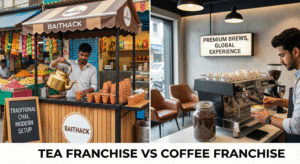
Tea Franchise vs Coffee Franchise is the key comparison for entrepreneurs entering India’s growing beverage market. Understanding which model offers higher profit margin, lower investment, faster break-even, and better long-term scalability helps business owners choose the right franchise. With tea and coffee both gaining popularity across India, comparing these two models is essential before making a franchise investment decision.Tea Franchise vs Coffee Franchise remains the most important comparison for entrepreneurs deciding which beverage segment offers better daily footfall and higher returns.
According to recent insights from Statista (https://www.statista.com), tea consumption in India remains significantly higher than coffee.
India’s Tea & Coffee Market Overview
India’s beverage landscape is shaped primarily by tea, a drink enjoyed daily across age groups, regions, and economic segments. From home kitchens to roadside stalls, tea has become a universal habit that naturally drives high consumption and repeat demand. Coffee, on the other hand, has carved out a strong presence in metro cities through premium cafés, lifestyle branding, and a growing culture of work and social meetings in café spaces.
As consumer lifestyles evolve, both beverages are benefiting from trends such as office cafés, youth meetups, digital work culture, and the rising preference for quick, on-the-go drinks. While both segments offer promising growth, tea holds a much wider penetration and a significantly lower cost per serving. This combination creates a larger customer base and stronger everyday demand, making tea a more accessible and scalable business model for new entrepreneurs.
Understanding the Tea Franchise Model
The tea franchise model in India is built around simple, flexible formats such as kiosks, takeaway outlets, compact cafés, and small seating spaces. These formats allow entrepreneurs to start with a much lower investment compared to most other food and beverage businesses. The per cup cost of tea is also minimal, which naturally results in high profit margins and strong repeat demand throughout the day. Operational requirements are fairly simple and usually need only a small team, basic equipment, and easy-to-manage workflows. When analysing Tea Franchise vs Coffee Franchise, tea clearly stands out due to its lower investment requirement and stronger repeat demand cycle.
Brands like Baithack take this already efficient model to a higher level by offering standardised SOPs that ensure consistent taste, smooth operations, and controlled costs. Their menu is designed for high profitability with premium chai variants and snack add-ons that enhance customer value while maintaining excellent margins. This makes the tea franchise model, especially with Baithack, a highly attractive option for first-time business owners.
Understanding the Coffee Franchise Model
The coffee franchise model typically requires a much higher initial investment because it relies heavily on advanced equipment such as espresso machines, grinders, and refrigeration units. Most coffee outlets also need premium real estate in high footfall areas along with well-designed seating arrangements that match the expectations of café culture. These factors increase the upfront cost as well as ongoing expenses. Operational costs are also higher due to specialised staff training, imported coffee beans, maintenance of equipment, and the need to create a pleasing ambience for guests. A major factor in the Tea Franchise vs Coffee Franchise comparison is how coffee outlets depend heavily on premium locations and costly equipment.
Coffee franchises primarily attract customers in metro cities, urban hubs, and premium neighbourhoods where consumers are willing to pay more for branded experiences. Although the per cup selling price is significantly higher than that of tea, the overall margins often reduce once rent, salaries, raw materials, and décor-related overheads are factored in. As a result, break-even tends to take longer in a typical coffee franchise model. Industry reports from IBEF (https://www.ibef.org) show strong growth in India’s food and beverage sector, increasing franchise opportunities.
Cost Comparison: Tea vs Coffee Franchise
When comparing the cost structures of tea and coffee franchises, the difference is clear. Tea franchises require a much lower initial investment, while coffee outlets demand a higher budget because of advanced machines, premium interiors, and larger spaces. Operational expenses such as rent, manpower, and equipment maintenance are also significantly higher in coffee cafés. Inventory costs further widen the gap since tea uses simple, affordable ingredients, whereas coffee requires expensive beans, flavoured syrups, and regular machinery upkeep.The biggest cost gap in Tea Franchise vs Coffee Franchise comes from the difference in raw materials, equipment, rent, and staff requirements.
In this comparison, Baithack stands out as a low-cost entry option. Its optimised setup, simplified operations, and budget-friendly infrastructure make it one of the most cost-efficient beverage franchise models in India.
Profit Margin Comparison
Tea franchises generally offer stronger profit margins because the raw material cost is extremely low, allowing owners to earn high gross margins on every cup sold. Since tea attracts repeat customers throughout the day, the business benefits from consistent, volume-driven revenue. With Baithack, these margins improve even further due to affordable sourcing, efficient operations, and profitable add-ons such as snacks and speciality chai variants.Profitability in the Tea Franchise vs Coffee Franchise debate shifts strongly toward tea franchises because of their lower operational costs and high-margin menu items.
Coffee franchises, while able to charge a premium price per cup, often struggle with lower net margins because operational costs are significantly higher. Imported beans, skilled staff, premium interiors, and equipment maintenance all reduce profitability. This also leads to a slower break-even period, especially in locations with limited footfall. All beverage franchise outlets must comply with FSSAI guidelines for food and beverage safety (https://www.fssai.gov.in).
Why Baithack Outperforms Coffee Franchises in Profitability
Baithack stands out in the beverage franchise space because its menu is built around high-margin items such as kulhad chai, refreshing cold beverages, and popular snack options that boost average order value. The brand follows a low investment model that pairs naturally with high daily footfall, allowing franchise owners to generate strong returns even in compact store formats. Baithack’s flexible setup can be adapted to metros as well as Tier 1, Tier 2, and Tier 3 cities, which greatly expands its market potential.Insights from the NRAI Food Service Report (https://nrai.org) highlight rising café culture and expanding beverage consumption trends.
Its streamlined operations reduce the need for large staff teams and minimise wastage, which further improves overall profitability. The brand also offers a strong identity and consistent taste while keeping the infrastructure and running costs affordable. As a result, Baithack often achieves a faster break-even period compared to coffee cafés that depend on premium locations and higher operational budgets.
Final Verdict
Both tea and coffee franchises hold strong opportunities in India, catering to different customer segments and business goals. Coffee franchises are aspirational and appeal to premium audiences, but they come with high setup costs, complex operations, and slower break-even timelines. Tea franchises, particularly with brands like Baithack, offer a compelling alternative with lower investment, higher profit margins, and a broader customer base. The volume-driven demand ensures faster returns, while streamlined operations make management easier. Overall, in the Tea Franchise vs Coffee Franchise comparison, tea franchises offer higher accessibility, faster break-even, and more stable daily revenue. For first-time entrepreneurs looking to maximise profitability without heavy financial risk, Baithack emerges as the ideal franchise choice.